A word can enter a museum as an idea. A warning sign enters before the idea, because a body is already moving through the room.
I. The Clean Word
Conceptual art gave language a new institutional authority. A sentence on a wall could take the place once held by an object. A title could become structure. A label could carry more weight than the material it named. A proposition could seem cleaner than paint, clay, labour, gesture or display.
That shift had force. It broke the old hierarchy in which manual skill carried the proof of seriousness. It opened space for instruction, context, definition, documentation and thought to become part of the artwork.
It also moved the gate. The viewer was asked to read the frame before trusting the encounter. The old gate was craft. The new gate was interpretation.
Cleaning Service begins at that gate. It returns to the word at the point where conceptual art made it appear stable. The project treats that stability as a surface that has been polished for too long.
A word works by removing detail. A chair becomes chair after texture, temperature, scale, use, price, damage, smell, memory, room and touch have been left behind. Language makes the removal usable. It turns a situation into something that can travel.
Cleaning Service takes that loss as its material.
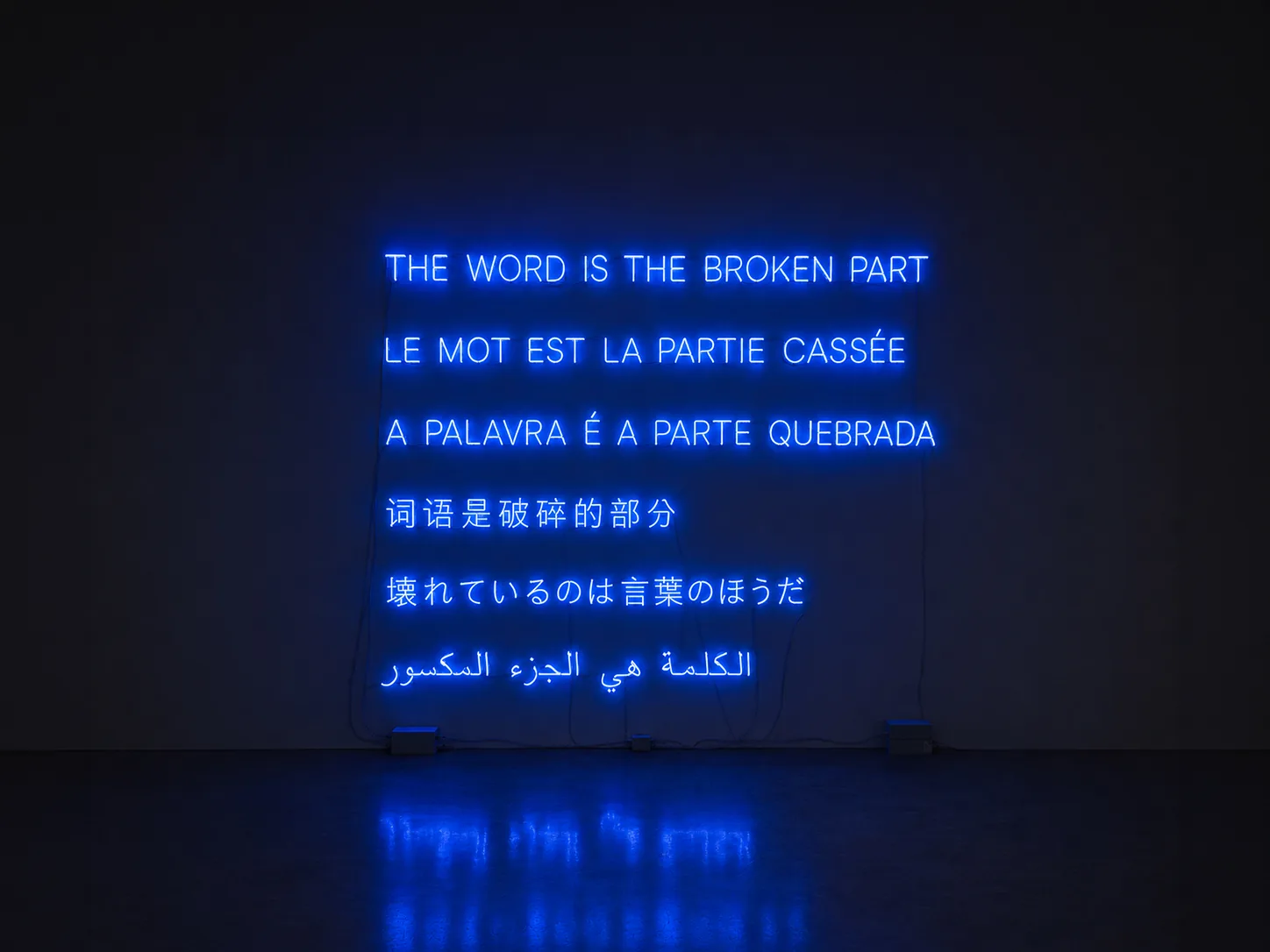
The work uses cleaning signs, broken neon sentences, warning symbols, multilingual fragments and generated installation studies. These forms belong to public space as much as to art. They are built for recognition, liability, instruction and control. They simplify a situation before the viewer has time to form an opinion.
A cleaning sign already understands what conceptual art often softened. Language is practical, partial and compressed. It manages a reduced version of the world.
The word is the broken part.
II. Kosuth and the Chair
Joseph Kosuth stands close to the centre of this problem.
In Art After Philosophy, Kosuth helped formulate one of conceptual art’s most influential claims. Art could be understood through analytical proposition. The artwork could define its own conditions. Appearance, craft and sensory force lost their privileged position.
One and Three Chairs makes the claim visible with rare clarity. A chair, a photograph of that chair and a dictionary definition of the word chair are placed together. Object, image and language appear beside each other as three channels of reference.
The familiar reading gives the work a generous intelligence. The chair is present. The image translates it. The dictionary defines it. No form secures the whole object. Representation is exposed.
Cleaning Service presses on another part of the work.
The chair is available to the body before theory begins. The photograph can travel across languages with little explanation. The dictionary definition is the narrowest channel. It depends on English, literacy, printed authority, institutional trust and a viewer trained to treat the definition as art.
Kosuth presents the word as the conceptual peak of the work. At the same time, the word is the least transferable element in the room.
The chair can be recognised before it is named.
The image can move before it is translated.
The definition needs a code before it can act.
This is the institutional reversal. Conceptualism attacked one form of authority and installed another. The artist no longer had to master the object. He had to master the conditions under which the object would be read.
The decisive skill became positional. Can the artist place the right sentence in the right room. Can the critic read the gesture as a proposition. Can the curator translate the proposition into legitimacy. Can the viewer accept that the experience has been relocated from the work into its explanation.
Cleaning Service attacks that hierarchy through a lower object. The warning sign has no need for reverence. It interrupts the body, then waits for consequence.
III. The Public Sign
The cleaning sign is a precise linguistic object because it is under pressure.
It carries no fantasy of purity. It reduces a situation into a command because a floor might be wet, a visitor might slip, a corridor might close, a worker might need access or an institution might be liable.
Caution. Wet floor. Cleaning in progress. Do not enter. Mind the step. Authorized personnel only.
These phrases are crude, useful and exposed. They do not require a catalogue before they begin to operate. They already know their task. Interrupt movement. Redirect attention. Prevent damage. Protect the institution. Translate risk into typography.
Placed in a gallery, the cleaning sign becomes a correction to the museum label. The museum label arrives after the artwork and claims to clarify it. The cleaning sign arrives before the event and tries to control it. One explains meaning. The other manages consequence.
Cleaning Service brings these systems together. The warning sign enters the museum as a minor institutional object that already understands compression. It turns danger into colour, movement into instruction, liability into layout and bodily risk into a symbol.
This makes it a stronger model of language than the conceptual proposition that treats the sentence as thought itself.
The cleaning sign knows that every instruction is a reduction.
It knows that public language survives through incompleteness.
It knows that a symbol must sacrifice precision to become usable.
Cleaning Service keeps the sign awkward, industrial, bright, cheap, repetitive and slightly embarrassing. That embarrassment matters. Conceptual art often purified language into coolness. The cleaning sign returns language to the floor.
The gallery is full of words that want to be interpreted. Cleaning Service introduces words that want to be obeyed, mistranslated, repaired, ignored or stepped around.
IV. Broken Neon
Neon gives language a body.
A sentence in neon becomes glass, gas, transformer, cable, colour, heat, voltage, reflection and architectural mood. It enters the room as a physical event.
This matters because Cleaning Service is concerned with the moment when language stops behaving like clean thought and starts behaving like material. Broken neon makes that moment visible.
A damaged letter still tries to speak. A flickering word still asks to be read. A failed tube turns meaning into voltage. The viewer receives a sentence and a malfunction at the same time.
The project uses phrases that sound institutional, instructional or overly clear.
The bluntness is deliberate. The sentences refuse the elegance through which conceptual language often protects itself. They behave like notices, warnings, repairs and temporary instructions.
Neon also carries seduction. It belongs to advertising, nightlife, storefronts, hotels, cinemas, emergency signs and commercial promise. When conceptual art used language, it often wanted intellectual coolness. Neon pulls that language into glow, desire, failure and public address.
Cleaning Service turns conceptual language into signage and signage into broken philosophy. It moves between museum sentence, public warning, commercial light and failed instruction.
V. The Maintenance of Meaning
Cleaning Service is built around a simple reversal. Conceptual art often treated language as the clean instrument that could escape the mess of the object. Cleaning Service treats language as the mess that the object reveals.
A wet floor sign, a broken neon tube, a translated warning, a pictogram and a museum label all perform one operation. They reduce a situation into a readable form. They select what can travel and leave the rest in the room.
The project asks what happens when that remainder becomes central.
What happens to the chair before it becomes chair.
What happens to the image before it becomes illustration.
What happens to the body before it becomes viewer.
What happens to the warning before it becomes language.
What happens to the artwork before it becomes proposition.
Cleaning Service returns to aesthetic experience as a harder problem than conceptualism allowed. The encounter with a work is never fully contained by the words that frame it. Something remains in surface, scale, glare, timing, danger, distance, embarrassment and bodily reaction.
That remainder carries force. It is where the work continues to think after language has reached its edge.
The project stages its own contradiction with full awareness. It uses language to expose the overconfidence of language. It uses signs to reveal the weakness of signs. It uses public instruction to interrupt the private prestige of art discourse.
Every label has a cleaner.
Every definition leaves residue.
Every institution polishes its own language.
Cleaning Service enters that polished space with a mop, a warning sign and a broken sentence.